The Australian Feminist Legislation Project
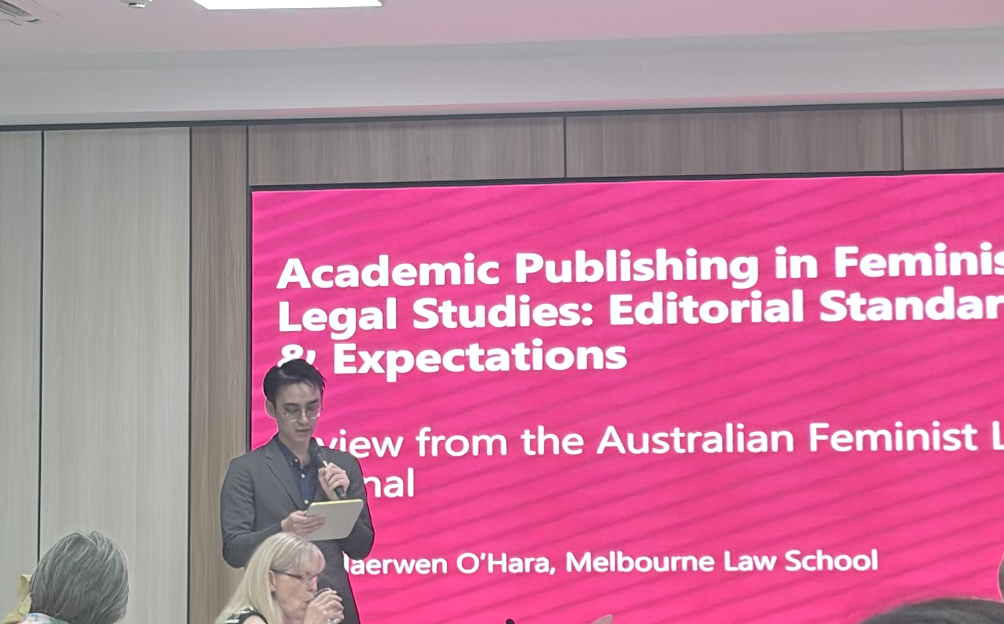
The leading presenter introduced the Australian Feminist Legislation Project, a collaborative initiative involving 46 academics, lawyers, and activists who worked together to rewrite existing legislation and draft entirely new parliamentary laws with the explicit goal of benefiting women, non-binary, and gender-diverse people. This project is distinct from other feminist legal projects around the world, which typically focus on rewriting judicial decisions or court judgments. Instead, this project worked at the level of parliament arguing that legislation is one of the most powerful tools available for gender reform, particularly in countries like Australia that do not have a national bill of rights. A key concept introduced in this session was skeptical pragmatism, defined as a feminist approach that is willing to engage with law and legal institutions despite knowing their limits and risks. Rather than rejecting law as inherently patriarchal, skeptical pragmatists work carefully and critically within legal systems to push for change. The project also developed a set of feminist principles for drafting legislation, including the use of plain language to make laws accessible to people without legal training, gender-inclusive language throughout all legislative texts, and the inclusion of feminist interpretive guides within the laws themselves to help judges and decision-makers understand the intent behind the legislation.
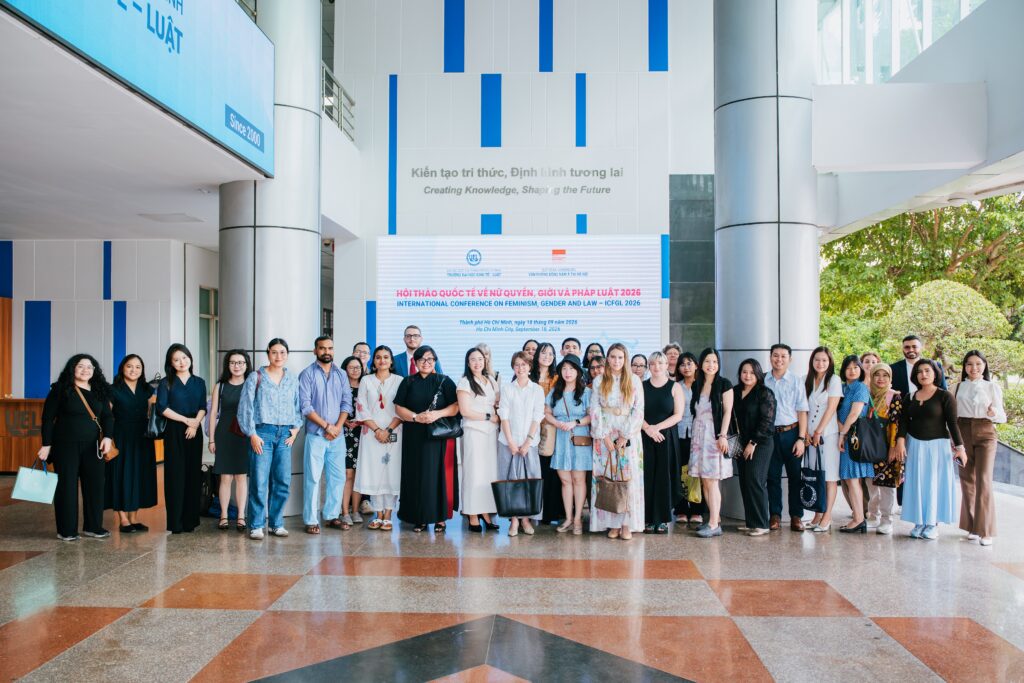
The proposals developed through this project covered a wide range of areas, including reproductive rights, modern slavery and gender-sensitive due diligence in corporations, social security payments for single mothers, aged care rights for elderly women, and electoral rights for incarcerated Aboriginal women. What struck me most about this session was the emphasis on being both legally rigorous and politically ambitious at the same time, the project required every proposal to be technically correct under Australian law, while also encouraging contributors to be as bold as possible in imagining what gender justice could look like.
Imagining a Feminist Law School
An Irish legal scholar took a very different and more creative approach. Rather than working within existing legal structures, she used imagination as a research method to envision what a feminist law school could look like. She located this imaginary institution on a fictional island called Hy-Brasil, which appeared on old maps off the west coast of Ireland, as a way of freeing herself from the constraints of existing institutions and asking more open questions about what legal education could become. She drew on three key methods. The first was prefiguration, the idea of acting as if a desired future already exists in order to bring it closer to reality. She used the example of Mary Robinson’s 1990 election as Ireland’s first female president as a moment of prefiguration, a breakthrough that was possible because generations of feminist activists had already been living and working as if women belonged fully in public and political life. The second method was utopianism using imaginative speculation to picture entirely different social and legal arrangements, drawing on a long tradition of feminist utopian writing going back as far as Christine de Pizan’s 1405 work. The third method was anti-hagiography, a critical approach to history that challenges the idealized, one-sided accounts that tend to erase the contributions of women and the contradictions within institutions.
What I found most valuable about this session was the argument that imagination is not just a creative exercise but a legitimate scholarly and political tool. Imagining a different kind of institution helps us see that current arrangements are not inevitable, and that there are always other ways of doing things.
The second challenge is backlash. Even laws that have been in place for decades can be reversed when political conditions change. She gave examples including the overturning of Roe v. Wade in the United States in 2022 after nearly 50 years; Turkey’s withdrawal from the Istanbul Convention on violence against women in 2021; and the UK’s For Women Scotland case in 2024, which significantly narrowed the legal recognition of transgender women. These examples showed that feminist legal gains are not permanent and must be actively defended. The third challenge is unintended consequences. She described a recent UK law named after a woman killed by her ex-partner designed to restrict the parental rights of fathers who murder their partners. However, when the regulations were drafted, it became clear that the law would also restrict the parental rights of mothers who killed their abusive partners in self-defense. This was an example of feminist lawmakers failing to account for the different situations of different women, and the devastating consequences that can follow from that oversight.
Despite all of this, she did not argue that feminist lawmaking should be abandoned. Instead, she made the case for the value of imaginative feminist legal projects as spaces to experiment with ideas, test their implications, identify unintended consequences before they cause harm, and build solidarity among feminists with different perspectives.
These all are meaningful to my MSc thesis, which examines child protection advocacy inside a Thai Buddhist monastery in Doi Saket District, Chiang Mai Province. The monastery houses displaced novice monks from Myanmar, and my research looks at how an outside faith-based organization, communicates and localizes child protection principles within this institutional setting through a gender lens. The concept of skeptical pragmatism helps me theorize the position of faith-based advocates in my study. They are not trying to dismantle the monastery system or challenge Thai Theravada Buddhism as a whole. Instead, they are working carefully and critically inside a patriarchal institutional structure, pushing for child protection norms while navigating the constraints of that structure. This is exactly what skeptical pragmatism describes cautious, realistic engagement with a flawed institution in the hope of producing meaningful change. The concept of prefiguration helps me understand their initiative as more than just a program. It is, in effect, modeling what a child-safe Buddhist institution could look like acting as if that institution already exists in order to help bring it into being. Even if the current results are limited, the act of introducing safeguarding language, training, and awareness into a space that previously had none is itself a form of prefigurative practice.
The discussion of implementation failure is perhaps the most directly relevant to my findings. My research found that child protection principles were communicated by advocates, but that the uptake and internalization of those principles among monks, novices, and institutional leadership was uneven and incomplete. The near-total absence of gender-specific language among monk and novice respondents in my interviews reflects not a failure of the advocacy itself, but a deeper structural normalization of silence within the patriarchal hierarchy of the monastery. The third presenter’s argument that cultural change is required, not just training supports my own Discussion chapter’s conclusion that safeguarding reform inside faith-based patriarchal institutions requires long-term structural engagement, not one-off interventions.
Finally, the symposium’s overarching theme, the tension between working inside patriarchal institutions and challenging them from within, is the same tension that runs through my entire thesis. My study is ultimately about what happens when an outside feminist-informed organization tries to introduce child protection norms into a total institution built on male hierarchy and religious authority. This conference gave me the theoretical language to name that tension clearly and to place my research within a broader global conversation about gender, institutions, and reform.
Attending this symposium was genuinely useful for my academic development. It introduced me to new theoretical frameworks, skeptical pragmatism, prefiguration, and the structural analysis of implementation failure that I can use to deepen the Discussion chapter of my thesis. More broadly, it reminded me that the challenge I am documenting in my research, the difficulty of protecting vulnerable people inside patriarchal institutions, is not a local or isolated problem. It is a challenge that feminist scholars and advocates around the world are actively grappling with, and my thesis contributes a specific and grounded case study to that wider conversation.
Aye Yeik Htin is part of the on-going Commissioned Research 2026 focus on Challenging Patriarchal Institutions and Strengthening Anti-Harassment Responses in ASEAN, to read more, visit:
Call for Commissioned Thematic Research 2026 | Challenging Patriarchal Institutions and Strengthening Anti-Harassment Responses in ASEAN